

Saverio Mercadante began composing the orchestral Garibaldi Symphony at the beginning of 1861 and completed it in March (the Kingdom of Italy was proclaimed on March 17). The success of this symphony is attested by the numerous reviews, transcriptions, and arrangements that followed. The “Reduction for Band by Ponchielli Amilcare, Music Director of the Cremona National Guard” was completed in Cremona on June 15, 1866, and first performed—according to the Corriere Cremonese—in a concert held in Piazza Cavour on September 6, 1866.
The symphony consists of a single movement divided into three broad sections, marked by changes in tempo and key, and further organized into subsections. The element that provides unity throughout the composition is the use of the Inno dei Cacciatori delle Alpi (later known as the Garibaldi Hymn, with text by Luigi Mercantini and music attributed to Alessio Olivieri), alongside the popular Milanese song La bella Gigogin.
An introductory episode leads into the Adagio, where the band plays the dominant of E♭ four times, fortissimo and in unison. At the same time, the lower instruments introduce the opening phrase of the Inno dei Cacciatori delle Alpi, which is then presented in full, pianissimo, by the clarinets and subsequently subjected to brief developmental passages.
The Andante, in 6/8, opens in A♭ with a lyrical and enveloping reworking of one of the melodies from La bella Gigogin (“a quindici anni facevo all’amore…”), set against a background of arpeggiated sextuplets resembling a waltz. After the episode is repeated in F, the Allegro bursts in harshly and dramatically, in 2/4 and tripartite form. A long introductory section precedes the return of the Garibaldi Hymn theme in E♭, first pianissimo and detached, then repeated and varied.
In the central section, still in 2/4 and in C♭, the composer once again recalls the melody “a quindici anni facevo all’amore…,” transforming and reshaping it until it reaches a grand fortissimo that fades, at the beginning of the third part, into a pianissimo with the Inno dei Cacciatori delle Alpi. An Ancora più animato then launches the triumphant final coda.
Centro Studi Amilcare Ponchielli
Giuseppe Riccucci
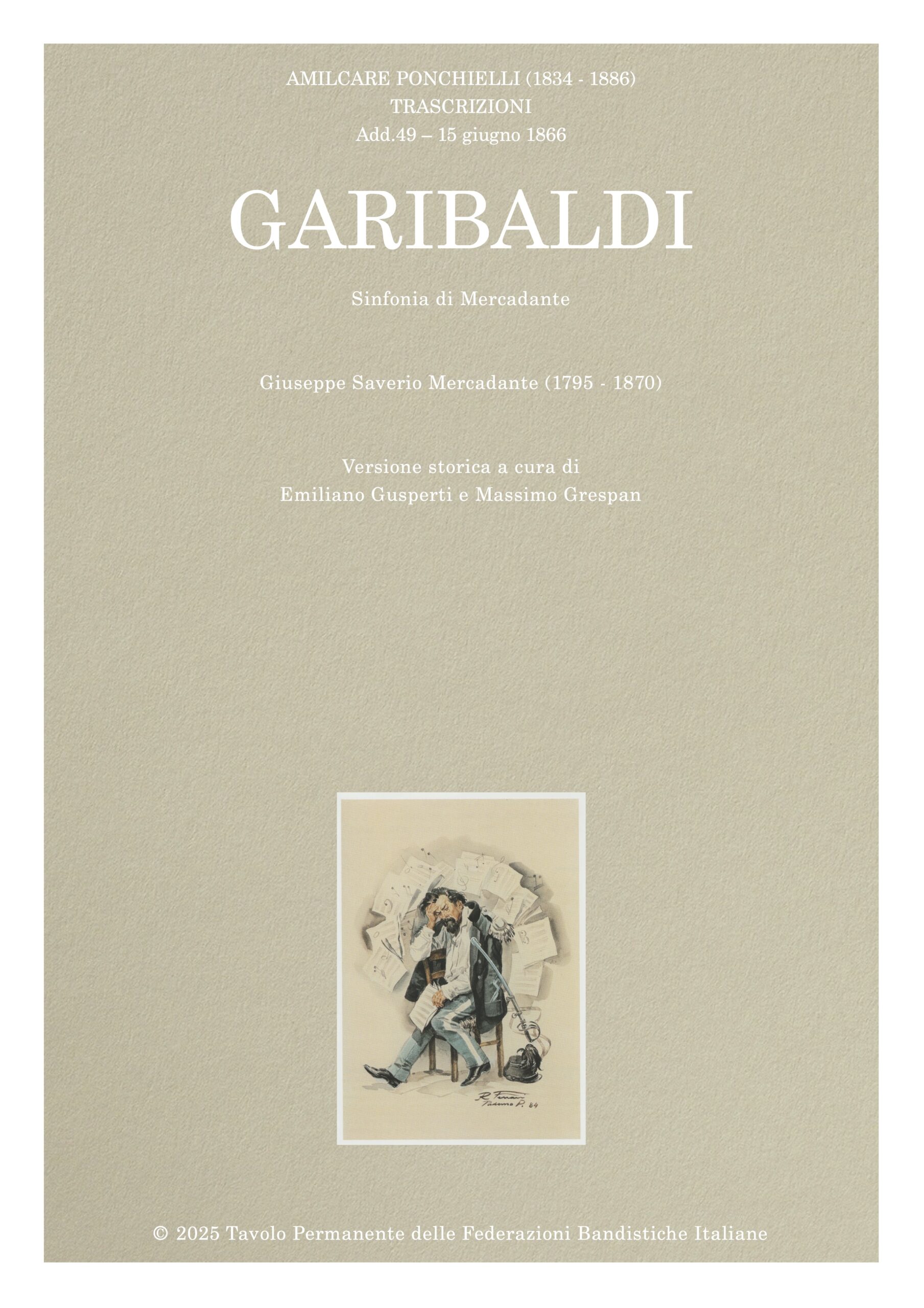
GARIBALDI - Historical version
GARIBALDI - Historical version - Audio
To view the original document